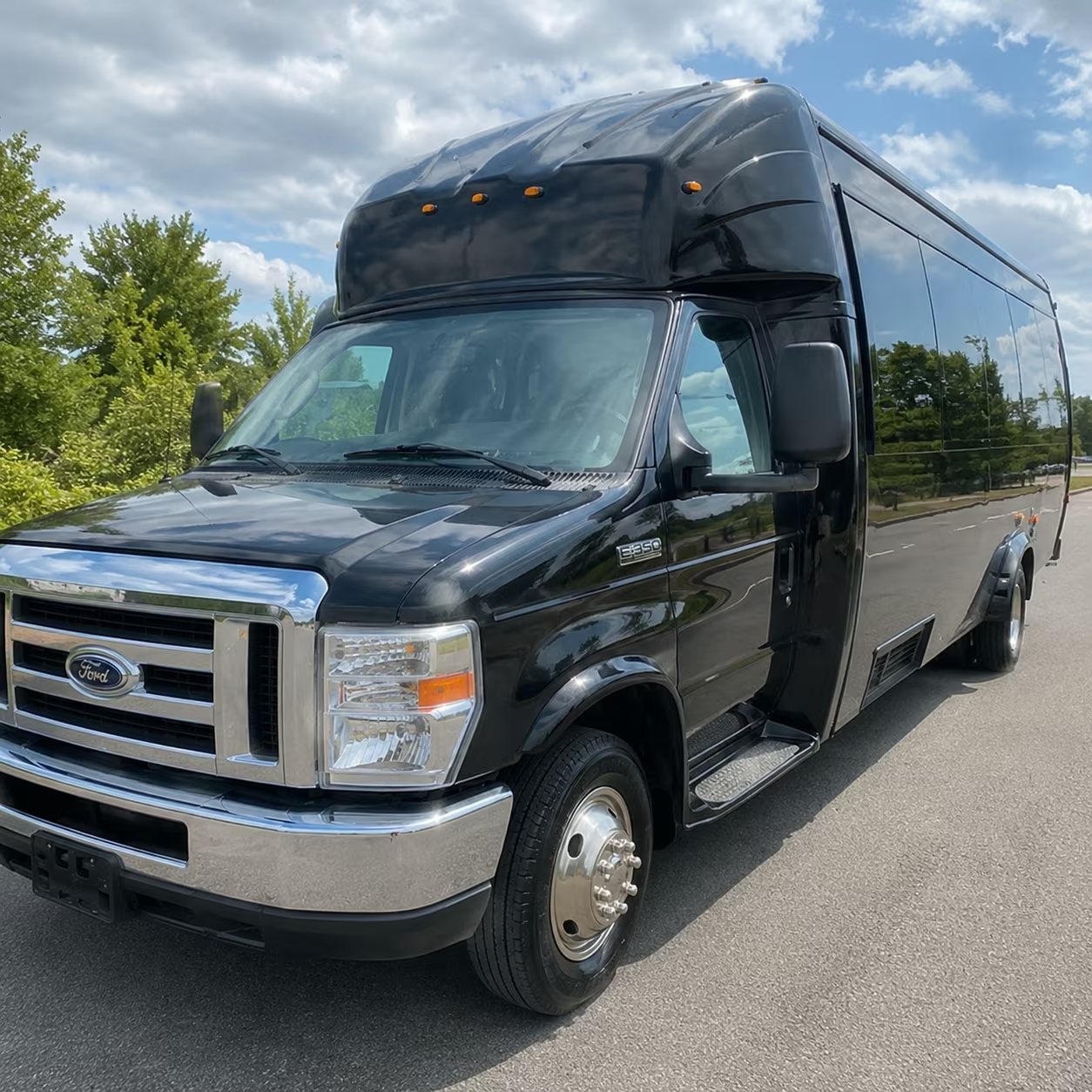
There are two kinds of group trips to JFK. The first: everyone scrambles for separate rideshares, watches the app surge to 2.3x the moment the flight lands, argues over who owes what at the Holland Tunnel toll, and arrives in waves at the terminal while two people are still stuck on the Van Wyck Expressway with a suitcase in their lap. The second: one bus picks everyone up, cuts across Queens on a clear route, drops the whole group curbside at the departures level, and the rest of the day belongs to the trip itself.
Those two experiences describe the same airport — and the difference is entirely in how you get there. JFK handles more than 62 million passengers a year and sits in the middle of a $19 billion rebuild that is reshaping every terminal, every road approach, and every pickup zone on the property. First-timers get turned around on the Van Wyck.
Groups with luggage lose half an hour just coordinating cars at baggage claim. A Manhattan party bus or charter bus to JFK cuts through all of that — one vehicle, one pickup window, one curb.
Why Rent a Bus to JFK Airport?
For a group of any size, the math on separate rideshares to JFK breaks down quickly. A yellow taxi from any point in Manhattan to JFK runs a flat $70 per the Port Authority's published flat-rate rule — before tolls ($6–$12), the New York State Congestion Surcharge, the MTA surcharge, a possible $5 rush-hour fee, and a tip. Most Manhattan-to-JFK rides land between $90 and $115 all-in, per vehicle, for up to four passengers.
Multiply that across six cars for a 24-person travel group and the tab hits $540–$690 each way — before anyone accounts for coordinating arrival times or sorting who rides with whom. A JFK charter bus rental or minibus keeps everyone in one vehicle on one invoice, with undercarriage bays for bags and luggage that never gets crammed into an Uber's trunk.
The construction reality makes the coordination problem even sharper. The Port Authority has confirmed that JFK construction is causing delays for all drop-off options and officially recommends public transportation when possible — but for groups with luggage, tight flight windows, or members who cannot navigate multiple AirTrain transfers, a private bus rental in Manhattan to JFK is the cleaner answer. No AirTrain fare per person, no sprint through Jamaica Station with a carry-on, no headcount at a terminal door.
The bus handles the approach, your group handles the check-in line.
JFK Terminal Guide: Which Terminal Is Your Flight?
JFK is mid-transformation. As of 2026, six terminals are active — Terminal 1, Terminal 4, Terminal 5, Terminal 6, Terminal 7, and Terminal 8 — with Terminal 7 transitioning out and the brand-new New Terminal One opening its first 14 gates in mid-2026. Know your terminal before your bus departs, because the approach roads now diverge much earlier than they used to and the wrong turn at the Van Wyck split costs real time.
Terminal 1 is the longtime international hub — Air France, Lufthansa, Japan Airlines, Korean Air, and Turkish Airlines — currently transitioning as the New Terminal One comes online next door. Terminal 4 is Delta's main operation and the busiest single terminal at the airport, also handling Emirates and most other international carriers not assigned elsewhere. Terminal 5 is JetBlue's home base, and Terminal 6 — the new $4.2 billion facility that opened its first gates in 2026 — picks up Lufthansa, SWISS, Austrian, Air Canada, ANA, Cathay Pacific, and several others.
Terminal 8 handles American Airlines and British Airways. Always confirm your terminal against your boarding pass — airline assignments are shifting as new terminals open and old ones close, and GPS may lag weeks behind the current road configuration on the property.
Always confirm your terminal on your boarding pass before the bus leaves. JFK's ongoing $19 billion rebuild has shifted airline assignments and terminal approach roads. Pulling up to the wrong terminal during the construction phase costs your group 20+ minutes and turns a smooth group transfer into a scramble.
Charter Bus and Party Bus Drop-Off at JFK Airport
At JFK, every terminal has its own departures-level curbside for drop-off, and that's where a bus delivering your group will pull up. Terminal curbsides are for active loading and unloading only — no staging, no long idles. The Port Authority enforces this with on-site staff, and the "no-idling" rule is real: the bus pulls in when your group is physically at the curb, bags out, and clears quickly.
For departures, this is a clean handoff — the bus drops the group at the departures level door for your terminal, and you're inside.
For arrivals pickups — collecting a group coming off a flight — the workflow matters. The two official free-wait options at JFK are the Free Wait Lot, which is closest to Terminals 1 and 4 and accessible by AirTrain, and the Cell Phone Lot (East) at 130th Place, Jamaica, NY 11430, which sits less than five minutes from Terminals 5, 7, and 8 per the airport's official pickup and drop-off page. The standard workflow: your group coordinator calls once everyone has bags and is standing at the agreed-upon arrivals curb, and the bus moves in from whichever lot it's staged at.
Do not call for the bus while half the group is still at baggage claim — timing at a high-traffic airport is everything, and an early pull-up only costs your group time and the bus a parking citation.
One logistical note that surprises groups: many full-size charter buses face height restrictions at terminal garages and some covered curbside access roads at JFK. This affects where an oversized vehicle can position during pickup. The clearest solution is confirming this detail with the company when you book — a minibus or mid-size vehicle avoids this entirely, and full-size coaches typically handle arrivals pickup from the open curb zones rather than any covered structure.
At Terminal 5 and Terminal 7, rideshare pickups between 12 PM and 2 AM now require a shuttle to a remote lot per Port Authority rules, but pre-arranged FHV and charter pickups are exempt from that shuttle requirement and can access the terminal curbside directly.
The Van Wyck, Belt Parkway, and Getting Your Group to JFK Without the Gridlock
The Van Wyck Expressway (I-678) is the primary artery into JFK from Manhattan, Brooklyn, and most of Queens — and it earns its reputation. The Van Wyck connects to the Long Island Expressway, the Belt Parkway, and the JFK Expressway at a series of interchanges that bottleneck hard during morning and evening rush hours. The section near the Kew Gardens interchange is the single worst chokepoint, and the approach to Terminal 4 via the Van Wyck saw its merge pattern adjusted in 2026 around the New Terminal One construction zone.
Eastern approaches via the Belt Parkway and JFK Expressway are the most disrupted as of 2026 — the Van Wyck from the west (Manhattan/Brooklyn side) remains comparatively stable, and GPS apps may lag the current construction signage by several weeks.
For groups coming from the Queens-Midtown Tunnel — the natural approach from Midtown Manhattan — the bus picks up the Long Island Expressway (I-495) east to the Van Wyck south. From the Brooklyn-Battery Tunnel side, the approach runs south along the BQE toward the Belt Parkway east, then Conduit Boulevard / North Conduit Avenue into the airport. Both routes converge on the Van Wyck before the terminal splits, and both require buffer time on any weekday between 7–9 AM or 3–7 PM.
A bus group that leaves Midtown at 4 PM for a 7 PM flight is walking a wire — that Van Wyck crawl is unforgiving, and a 45-minute off-peak ride becomes 90 minutes in the wrong window without warning.
For a 7 PM international departure, aim to leave Midtown by 3:30 PM at the latest. The Van Wyck hits its worst congestion between 4 and 7 PM on weekdays, and the JFK construction zone slows the approach to Terminals 1 and 4 further. Build in the buffer before you need it.
Drive Times from Manhattan, Brooklyn, Queens, the Bronx, Hoboken, and Jersey City
JFK sits at the southern edge of Queens — roughly equidistant from the dense urban neighborhoods that feed it. Here's a realistic picture of what to plan around for each origin point:
| From… | Approx. distance | Off-peak drive time | Rush-hour drive time | Primary route |
|---|---|---|---|---|
| Midtown Manhattan | ~16–18 miles | 40–50 min | 75–90 min | Queens-Midtown Tunnel → LIE → Van Wyck S |
| Lower Manhattan / Financial District | ~15 miles | 35–45 min | 60–80 min | Brooklyn-Battery Tunnel → BQE → Belt Pkwy → Conduit Blvd |
| Brooklyn | ~10–13 miles | 25–35 min | 45–60 min | Belt Parkway east → North Conduit Avenue |
| The Bronx | ~17–22 miles | 40–55 min | 75–105 min | Whitestone or Throgs Neck Bridge → I-678 (Van Wyck) S |
| Hoboken, NJ | ~20 miles | 35–45 min | 60–80 min | Holland Tunnel → BQE → Belt Pkwy → Conduit |
| Jersey City, NJ | ~21 miles | 40–50 min | 65–85 min | Holland Tunnel → BQE → Belt Pkwy or Van Wyck |
The Bronx-to-JFK run surprises groups the most. The distance isn't extreme — roughly 17 to 22 miles depending on the neighborhood — but the route crosses two of the most congested highway connectors in the metro: the Whitestone or Throgs Neck Bridge, and the full length of the Van Wyck. On a weekday afternoon, 90 minutes is a conservative estimate.
A bus group from the Bronx or northern Manhattan heading to JFK for an early evening departure should plan to board by 2:30 PM at the latest. New Jersey groups face the Holland Tunnel — the approach from Hoboken and Jersey City runs through the tunnel onto the BQE and Belt Parkway, which is efficient off-peak but notoriously backed up from midday into the evening on weekdays. Renting a charter bus or minibus from New Jersey to JFK means all of that tunnel-and-expressway time is handled without anyone needing to juggle navigation and luggage simultaneously.
Which Vehicle Fits Your Group for a JFK Run?
No two JFK groups need the same vehicle. A dozen corporate travelers heading to Terminal 1 for an international connection needs something different from 40 students catching a charter flight out of Terminal 5. Here's how the vehicle options break down for an airport run:
| Vehicle | Seats | Luggage capacity | Best for |
|---|---|---|---|
| 14-passenger Sprinter limo / Sprinter van | Up to 14 | Modest — carry-ons, a few checked bags | Small executive groups, wedding parties, small family travel |
| 15–35 passenger minibus | 15–35 | Overhead + some underfloor storage | Mid-size groups, hotel-to-terminal shuttles, corporate team travel |
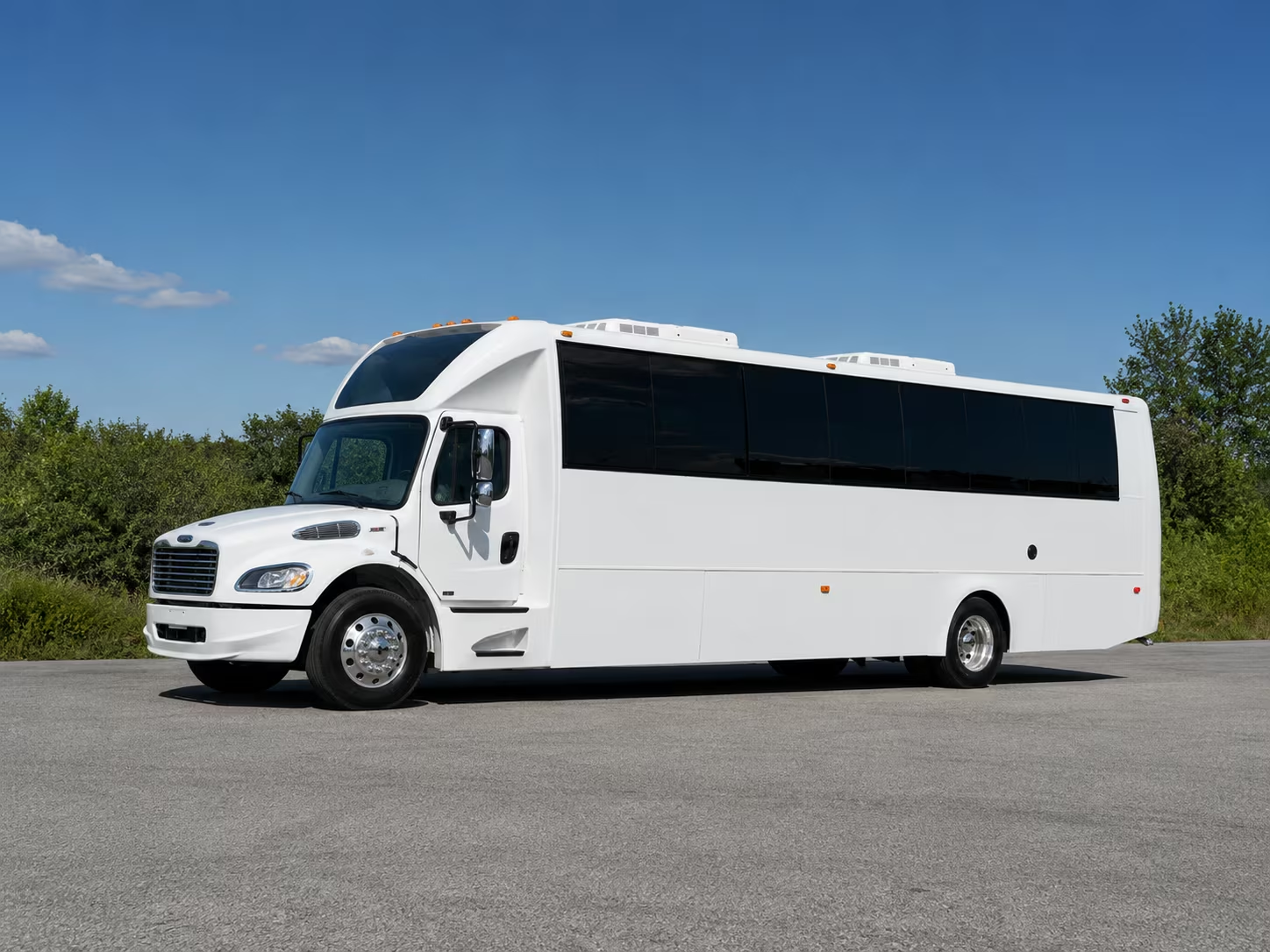
| 40–56 passenger charter bus | Up to 56 | Excellent — deep undercarriage bays | Large group travel, sports teams, school groups, convention delegations |
For airport runs specifically, luggage depth is the tie-breaker. A minibus is a great fit for 20–30 travelers moving carry-ons and one checked bag each — overhead storage plus underfloor bins cover most business travel configurations. Once the group grows past 30 or starts adding extended international luggage (multiple checked bags per person, oversized gear), a full-size charter bus with its deep undercarriage bays is the right call.
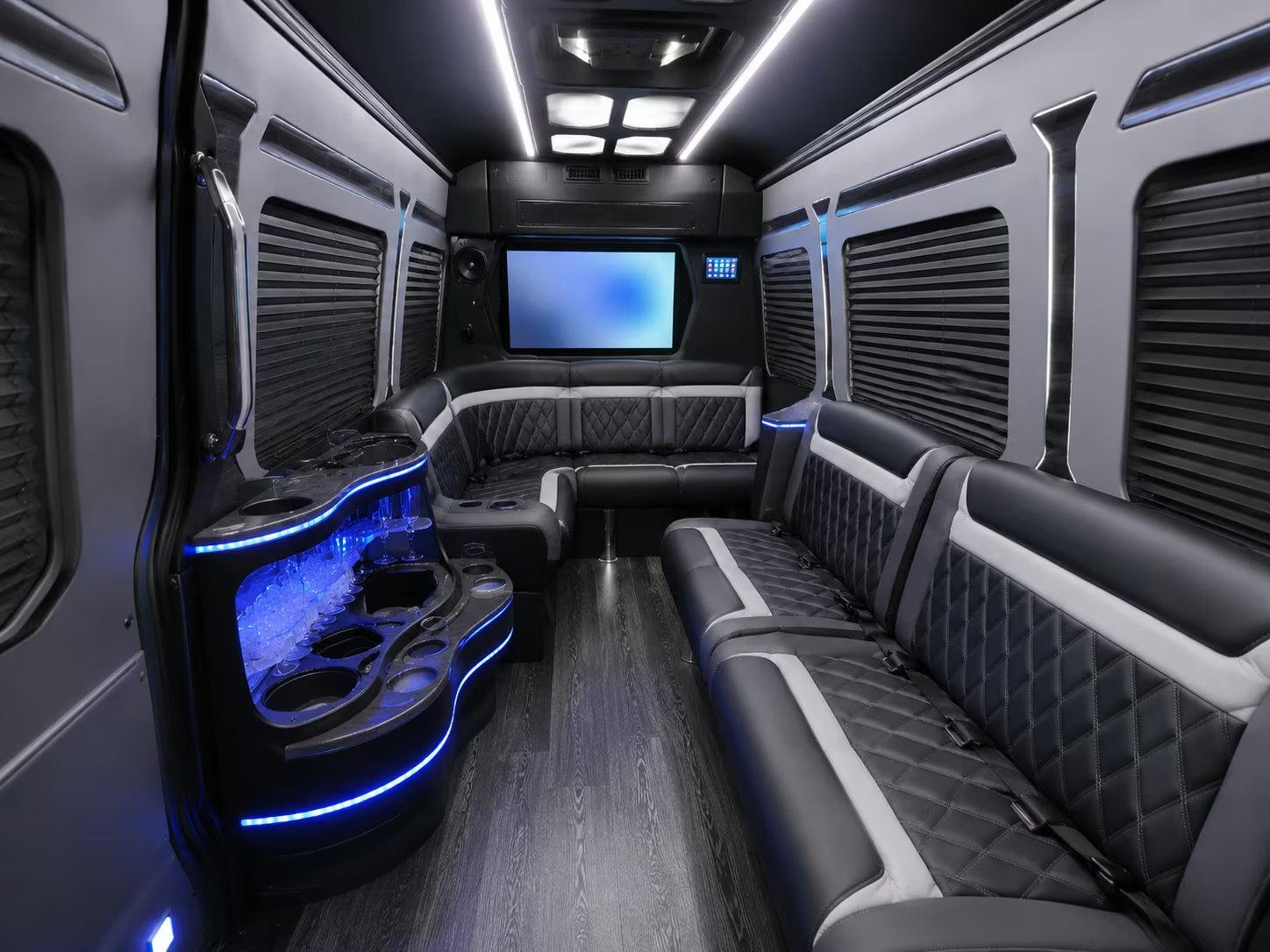
Party buses — with perimeter seating, onboard bars, and LED lighting — are typically requested for groups arriving at JFK for a big trip, not departing for one, since the energy going out to the airport rarely matches the energy coming home from somewhere else.
ADA-accessible vehicles are available through the network. Just note your requirements when you request a quote — the more lead time, the better the match. Call 929-529-0030 any time to check availability and compare vehicles for your exact headcount and luggage situation.
JFK Transportation Options Compared: Bus, Taxi, Rideshare, AirTrain
This is a bus-comparison website, but let's be straight with you: a private bus isn't automatically the right call for every trip. Here's an honest look at the main options, scored on what actually matters for group travel.
| Option | Cost shape | Arrive together? | Luggage handling | Best for |
|---|---|---|---|---|
| Charter bus or minibus rental | One flat rate split by the group | Yes — one vehicle, one arrival | Excellent — undercarriage bays | Groups of 15–56 with luggage |
| Yellow taxi (flat rate) | $70 flat + $20–$45 in tolls, fees & tip per cab | No — max 4–5 per cab | Trunk only, limited | 1–4 travelers, straightforward route |
| Rideshare (Uber / Lyft) | Varies — surges to 2–3x during peaks and rain | No — multiple cars, multiple ETAs | Trunk only | 1–3 travelers without tight timing |
| AirTrain + LIRR to Penn Station | ~$14–$16 per person (off-peak + peak) | Only if the group boards the same train | Carry-on only, no assistance | Solo or pair travelers with light bags |
| MTA Q10 bus + subway | $3.00 subway fare | No — multiple transfers | Very limited — no luggage storage | Solo budget travelers with carry-on only |
For one or two travelers with just a carry-on, the AirTrain to Jamaica and a LIRR train to Penn Station is hard to beat — roughly $14–$16 per person off-peak, and the AirTrain connects all terminals at no charge between them, with the paid fare only triggered when you exit at Jamaica or Howard Beach. The AirTrain fare is $8.75 per ride, and the combined LIRR off-peak CityTicket from Jamaica to Penn Station is $5.25 — total around $14 per person. That's a legitimate choice for a solo business traveler.
But for groups? The transit option requires everyone to carry luggage through multiple transfers, coordinate on the same train departure, and account for the construction-era disruptions on the terminal roads between the AirTrain platform and your check-in counter. A bus that drops the group at the departures curb eliminates every one of those friction points.
AirTrain JFK: When It Makes Sense and When It Doesn't
The AirTrain is a legitimate airport connector, and it's worth knowing how it works — because some groups use it one-way. The AirTrain loops continuously through all active terminals, both long-term parking areas, and the Federal Circle rental car center, with trains running every 5–15 minutes and travel between terminals at no charge. The fare kicks in only when you exit to Jamaica Station (LIRR + E, J, Z subway) or Howard Beach Station (A train).
That $8.75 exit fare plus your subway or LIRR connection covers the full journey into the city — but the connections require transfers, and there's no luggage storage or checked-bag handling along the way.
For groups using a charter bus or minibus to get to JFK, the AirTrain is often useful in the opposite direction — for a meeting point or terminal-to-terminal reconnection after landing, when the group is splitting up. It's also the right call for the Free Wait Lot connection near Terminals 1 and 4, where the AirTrain links the lot to the terminal in about 8 minutes. Knowing this helps your group coordinator plan the pickup sequence: bus stages at the Free Wait Lot, coordinator takes the AirTrain to confirm everyone is at the curb, then the bus pulls in.
That's the tight choreography that keeps a big group moving through JFK without losing 45 minutes at baggage claim.
Manhattan to JFK Bus Rental Prices
Bus rental rates for a JFK airport run depend on your group size, how many hours the vehicle is needed, the date, and your specific pickup and drop-off locations. To give you an idea of planning ranges: a 15–35 passenger minibus typically runs $200–$275 per hour on weekdays and $200–$275 per hour on weekends, with per-day rates in the $1,100–$2,150 range. A 40–56 passenger charter bus typically runs $200–$350 per hour, with per-day rates from $1,350–$2,850.
These are planning ranges — the real quote moves with your specific date, headcount, and hours, and you can get one in under 30 seconds by calling 929-529-0030 or using the online form.
Per-person math makes the case clearly. A 30-person group booking a minibus at $230/hour for a 3-hour round-trip window to JFK comes to roughly $690 total — about $23 per person. That same group in separate taxis would spend $90–$115 per vehicle, or roughly $675–$862 for six to seven cabs, with no guarantee everyone arrives together and no luggage overflow.
The bus is usually the simpler and cheaper option the moment you're past eight to ten people. Check the Manhattan party bus prices page for a full look at the rate ranges, or call 929-529-0030 any time — no account required, no obligation.
The Arrival Pickup Workflow: What Actually Happens at JFK
Group pickups at JFK go smoothly when the sequence is right and fall apart when they're not. Here's the workflow that keeps a 30-person arrival pickup from turning into a 90-minute curbside pileup:
- Designate one coordinator. One person manages communication with the bus — not the whole group texting at once from baggage claim. Everyone else follows the coordinator's lead on when to head to the curb.
- Confirm your terminal before you land. JFK airline assignments have shifted with the new construction. Check the boarding pass, not memory — especially for Terminal 1, which is transitioning to the New Terminal One footprint.
- Gather first, call second. The bus cannot legally stage at the curb until your group is physically present. Once everyone has bags and is at the arrivals level, the coordinator calls — the bus moves from the Free Wait Lot or Cell Phone Lot East and pulls in.
- Move quickly at the curb. Curbside dwell enforcement at JFK is active, especially at Terminal 4 during international evening peaks. Bags in the undercarriage bays, group boarded, bus moving — that turnaround should take under 5 minutes.
- Know the lot in advance. For Terminals 5, 7, and 8 pickups, the Cell Phone Lot East at 130th Place, Jamaica, is less than five minutes away per the airport's own guidance. For Terminals 1 and 4, the Free Wait Lot with the AirTrain connection is closer. Confirm the staging lot before the group lands.
If anything on the terminal side changes — a construction reroute, a curbside closure, a gate change — having one coordinator fielding calls from the bus is infinitely better than 30 people trying to locate each other across the arrivals level. The bus handles the driving; your coordinator handles the handoff.
When to Book and What Changes the Price
JFK demand is year-round, but certain windows are tighter than others. Summer travel season (June through August) is the busiest stretch for group departures — families, school trip groups, and corporate delegations all converge on JFK in the same window. Holiday travel (Thanksgiving week, the week before Christmas, and the spring break window in March–April) generates similar crunches.
For those dates, booking your Manhattan JFK bus rental at least 4–6 weeks in advance gives you the best vehicle selection and the most competitive rates. For large groups (40+ passengers, multiple buses), 8–10 weeks is a safer window.
The Van Wyck Expressway construction is an ongoing variable — the New Terminal One is expected to open its first 14 gates in mid-2026, and Terminal 6 gates are coming online through late 2026. That means the approach-road configuration and terminal assignments are still actively shifting. When you book, confirm the current terminal for your airline — a JFK group bus rental booked in advance can have the approach route adjusted up to departure, while a last-minute rideshare scramble cannot.
For the clearest current picture on terminal road patterns, the Port Authority Builds terminal page stays updated as construction progresses.
Rentals from Brooklyn, Queens, the Bronx, Hoboken, and Jersey City
JFK is a Queens airport, which means neighbors get the best of it and New Jersey travelers pay the bridge-and-tunnel toll in time. From Brooklyn, the Belt Parkway to North Conduit Avenue is the natural route — roughly 10–13 miles, running 25–35 minutes in light traffic and 45–60 minutes during rush hour. A Brooklyn party bus rental to JFK catches the Belt Parkway at its most direct, and groups in neighborhoods like Park Slope, Bay Ridge, or Flatbush benefit from the fact that the Belt runs directly into the airport's Conduit approach without needing to touch the Van Wyck at all.
From Brooklyn, that is the cleanest entry into the airport in the borough grid.
From Queens itself — Flushing, Jamaica, Forest Hills, Long Island City — JFK is practically in the neighborhood. The Van Wyck runs due south from the Grand Central Parkway interchange, and groups in central Queens can hit the airport in 15–25 minutes off-peak. From Queens, a minibus makes more logistical sense than a full charter bus for most group sizes, since the shorter distance doesn't require the overnight amenities of a longer run.
From the Bronx, the Whitestone Bridge or Throgs Neck Bridge connects onto I-678 southbound toward JFK, and the full run is roughly 17–22 miles. That sounds reasonable until you factor in a 4 PM departure on a weekday — Bronx-to-JFK in the late afternoon is a 90-minute commitment, sometimes more. Groups from the Bronx heading to JFK should build in generous buffer, and a charter bus that handles the whole Bronx-to-Queens corridor lets everyone settle in while the expressway sorts itself out.
From Hoboken and Jersey City, the route runs through the Holland Tunnel — the primary connection from Hudson County into Brooklyn and Queens. Off-peak, the drive is 35–50 minutes. On a weekday afternoon, the Holland Tunnel approach can add 20–30 minutes before the tunnel itself.
Riders from Hoboken and Jersey City are also JFK's farthest frequent travelers — they pay the tunnel toll and the Van Wyck traffic — which makes a single group bus particularly valuable: one toll, one vehicle, one destination.
JFK Construction in 2026: What Your Group Needs to Know
The Port Authority's Whole New JFK program is the largest airport rebuild in United States history, and it's happening while the airport stays fully operational. That combination creates a specific planning challenge: road configurations are actively changing, terminal approach signs are being updated faster than GPS apps can track, and new drop-off zones are being stood up as new terminals open. The Port Authority's official JFK rebuild page tracks the major project milestones and is the most reliable source for construction-era updates.
The practical impact for group travel in 2026: eastern approaches via the Belt Parkway and JFK Expressway toward Terminals 1 and 4 are the most affected by construction reroutes. The Van Wyck approach from the west — which carries most Manhattan, Brooklyn, and Jersey City traffic — is comparatively stable, but Terminal 4's merge pattern near the New Terminal One construction zone has been adjusted, with right-lane routing now required. Speed limits in the construction zone are reduced to 25 MPH with enforcement cameras.
For Terminals 5 and 8, disruption has been minimal. Follow orange construction signs over GPS when they conflict — GPS apps may be 2–6 weeks behind current road geometry at JFK.
Practical Tips for a Smooth JFK Group Trip
- Confirm your terminal first. Pull up your boarding pass before the bus departs. For New Terminal One arrivals beginning mid-2026, look for "NTO" or "New Terminal One" designation rather than "Terminal 1" in some airline systems.
- Budget 90 minutes from Midtown on weekday afternoons. A 4 PM departure from Midtown Manhattan that hits the Queens-Midtown Tunnel at 4:15 PM is walking into the worst of the Van Wyck backup. The only solution is leaving before 3:30 PM or after 7 PM.
- Have one coordinator on call. One person manages bus communication on arrival — not the whole group. That single contact point is what keeps a 30-person pickup from dissolving into chaos at the baggage carousel.
- Check the Port Authority's construction advisories. The Port Authority travel advisories are updated weekly and call out specific construction impacts by terminal and date.
- Save the airport contact. JFK International Airport's main customer service line is (718) 244-4444 — useful if anyone gets separated or a terminal curbside is temporarily rerouted.
- ADA-accessible vehicles are available. Note your requirements in the quote request — the earlier the better, since these vehicles book quickly for high-demand travel dates.
Frequently Asked Questions
Where exactly does a charter bus drop off at JFK?
Charter buses drop at the departures-level curbside in front of each terminal — the same active loading zone used by taxis and rideshares. There is no dedicated charter bus loading dock at JFK separate from the general departures curb. The curbside is for active drop-off only, and vehicles must clear promptly.
For arrivals pickup, buses stage at the Free Wait Lot (closest to Terminals 1 and 4) or the Cell Phone Lot East at 130th Place, Jamaica (closest to Terminals 5, 7, and 8), then move in once the coordinator confirms the group is at the curb with all bags.
What is the AirTrain fare at JFK?
The AirTrain fare is $8.75 per ride when exiting at Jamaica Station or Howard Beach Station to connect with the subway or LIRR. Travel between terminals on the AirTrain is free — you only pay when you exit the airport's loop to public transit. Children under 5 ride free.
The combined LIRR CityTicket from Jamaica to Penn Station is $5.25 off-peak or $7.25 peak, making the total trip Penn Station to JFK roughly $14 off-peak. More information is on the official AirTrain JFK page.
How far is JFK from Manhattan?
JFK sits roughly 15–18 miles from Midtown Manhattan, depending on which neighborhood you're starting from. Off-peak, that's 40–50 minutes via the Queens-Midtown Tunnel and Van Wyck Expressway. During rush hour — especially weekday afternoons from 3 to 7 PM — plan on 75–90 minutes.
Lower Manhattan groups using the Brooklyn-Battery Tunnel route to the Belt Parkway can sometimes save 10–15 minutes over the Midtown Tunnel route when Midtown traffic is heavy.
How much does it cost to park at JFK?
On-airport parking at JFK runs $55–$94 per day depending on the lot — the Terminal 4 Blue Lot is highest at approximately $94 per day, the Long-Term Lot is lowest at approximately $55. Pre-booking online cuts those rates significantly, with reservations typically landing in the $36–$48/day range. Off-site lots near the Van Wyck Expressway run $10–$31/day with free shuttle service to all terminals.
For a group of 10 people sharing a single rental car, those daily rates quickly eclipse the cost of a shared minibus, without the convenience. The full breakdown is on the JFK parking page.
What is the flat-rate taxi fare from JFK to Manhattan?
Yellow taxis from JFK to anywhere in Manhattan charge a flat rate of $70, per the Port Authority's published rate on the official taxi page. On top of that: tolls, plus $2.75–$8.50 in additional fees that vary by time of day and destination, and a tip. Total out-of-pocket for most Manhattan rides: $90–$115 per cab.
That covers 4 passengers maximum (5 in a minivan) — for a group of 20, that's five cabs, approximately $450–$575, with no guarantee everyone arrives together.
Are buses affected by the JFK construction?
Yes — but the impact is manageable with advance planning. Eastern approaches to Terminals 1 and 4 via the Belt Parkway and JFK Expressway are the most disrupted as of 2026, with modified merge patterns and reduced speed limits in the construction zone. The Van Wyck approach from the west is comparatively stable.
GPS may lag the current road layout by several weeks — follow orange construction signs when in conflict with navigation apps. The Port Authority Builds JFK page has the most current construction updates.
How far in advance should I book a bus to JFK?
For summer travel (June–August) and major holiday windows, 4–6 weeks in advance is the right call to secure the vehicle size you need at a competitive rate. For large groups (40+ passengers), 8–10 weeks is safer. Off-peak and midweek runs can often be arranged with 2–3 weeks of lead time — but the earlier you lock in, the better your options.
Call 929-529-0030 any time to check current availability.
Can a bus pick up from multiple stops before JFK?
Yes — multi-stop pickups are a common request for JFK runs, especially for groups spread across Midtown, Uptown, and the outer boroughs. Just include all pickup locations in your quote request and the routing is built around them. A bus that collects the group from a Midtown hotel, a Brooklyn address, and a Queens stop before hitting JFK is a completely standard setup.
The total hours and mileage shape the quote, not the number of stops.
Book Your JFK Airport Bus Rental Today
Whether it is a 15-person corporate group catching a morning international departure from Terminal 4, a 40-person school trip loading through Terminal 5, or a 25-passenger group arriving from a transatlantic flight at the new Terminal 1, Partybusrentalmanhattan.com makes it easy to find and compare bus rentals to JFK across a large network of companies serving Manhattan and the surrounding area. Fill out one quick form — or call 929-529-0030 any time — and compare vehicles, routes, and rates in under 30 seconds. No account required, no obligation, and a support team ready to work through the details on any date.
Also coordinating transportation to MetLife Stadium or Madison Square Garden on the same trip? Those guides cover their own drop-offs in full.
The Van Wyck doesn't get any shorter. Book the bus and let it handle the drive while your group focuses on the trip.